


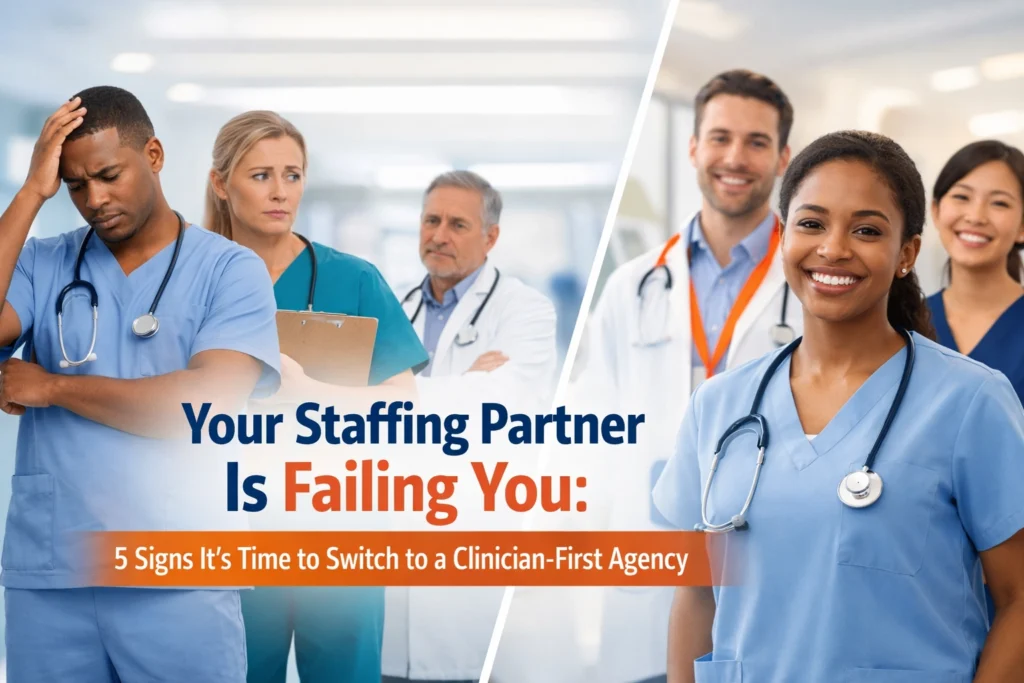
Let's be real: not all healthcare staffing agencies are created equal.
You might be sitting there right now, drowning in emails about no-shows, dealing with yet another credentialing nightmare, or explaining to your CFO why that "perfect" locums physician walked out after two weeks. Sound familiar?
Here's the thing, if your healthcare staffing agency treats clinicians like inventory numbers instead of the skilled professionals keeping your facility running, you're not just losing money. You're losing time, sanity, and probably some really good people.
So how do you know when it's time to cut ties and find a partner who actually gets it? Here are five red flags that scream "your staffing partner is failing you."
Sign #1: Communication Feels Like Pulling Teeth
Remember when you first signed with your staffing agency? They were everywhere. Emails, phone calls, promises about "being there whenever you need us." Fast forward to today, and you can't get a callback to save your life.
Quality healthcare staffing isn't a "set it and forget it" situation. When you're trying to fill critical roles, whether it's locums physicians for a busy ER or travel nurses for an understaffed med-surg unit, radio silence isn't just annoying. It's dangerous.

A clinician-first agency should offer:
- 24/7 support when you need it (not just business hours)
- Dedicated account managers who actually know your facility
- Proactive communication about candidate availability, not reactive "sorry, can't help" responses
- Real-time updates on credentialing, licensing, and onboarding status
If you're sending three emails before getting one vague response, that's not partnership, that's ghosting with a contract.
Sign #2: Administrative Chaos Is Your New Normal
Let's talk about everyone's favorite topic: paperwork. (Kidding. Nobody likes paperwork.)
If your internal team is spending more time chasing down expired certifications, tracking licensure renewals, and playing phone tag with references than actually managing your facility, your staffing partner isn't pulling their weight.
Here's what workforce flexibility actually looks like when you have the right partner:
- Centralized credential management that doesn't live in someone's email inbox
- Automated compliance tracking that flags issues before they become problems
- Streamlined onboarding that gets clinicians on the floor fast
- Complete handling of travel logistics for temporary placements
One facility director I talked to last month said their old agency's idea of "full-service" was sending over a checklist of what they needed to do. That's not service. That's a to-do list with a markup.

A true staffing partner takes that entire burden off your team. If you're still drowning in admin work, you're basically doing it yourself, and paying someone else for the privilege.
Sign #3: Your Clinicians Are Complaining About Compensation (and They're Right)
Pop quiz: When was the last time your staffing agency proactively talked to you about competitive rates in your region?
If the answer is "never" or "I can't remember," you've got a problem. And it's probably costing you good people.
Clinician-first agencies don't just throw numbers at the wall and hope they stick. They:
- Research and negotiate competitive pay rates that reflect actual market conditions
- Provide transparent breakdowns of compensation packages
- Include comprehensive benefits (health insurance, retirement plans, CE reimbursement)
- Offer stipends and support for travel assignments that actually cover real costs
When your temporary staff is making significantly less than they could elsewhere, and they know it because they talk to each other, they walk. And your staffing partner pockets the difference while you're left scrambling to fill the gap again.
If your agency treats compensation conversations like a used car negotiation, it's time for an upgrade.
Sign #4: They Send Resumes, Not People Who Actually Fit
You know the drill. You submit your staffing request with specific requirements about experience, certifications, and cultural fit. Three days later, you get a stack of resumes that look like they were pulled from a generic database with zero regard for what you actually need.
"Well, they have a medical degree" shouldn't be the bar.

Clinician-first agencies understand that credentials are baseline: not the whole story. The best partners focus on:
- Personalized job matching based on facility culture, not just skills checklists
- Pre-vetting candidates for technical competencies and soft skills
- Understanding your facility's unique challenges (rural vs. urban, patient demographics, EMR systems)
- Following up after placements to ensure it's actually working
When your healthcare staffing agency sends you a family medicine doctor who's never worked rural and doesn't want to, but "technically qualifies," that's not matching. That's lazy.
Culture fit isn't some HR buzzword. It's the difference between a clinician who integrates seamlessly and one who counts down the days until their contract ends (and complains the whole time).
Sign #5: Support Vanishes After the Placement
Here's where a lot of agencies show their true colors: what happens after they place someone?
If your staffing partner considers their job done the moment a clinician shows up for their first shift, you're not in a partnership: you're in a transaction.
Real support means:
- Regular check-ins with both your facility and placed clinicians
- Immediate problem-solving when issues arise (because they will)
- Career development resources for temporary staff who might become permanent
- Performance feedback loops that actually improve future placements

One of the biggest complaints I hear from facilities is that their agency disappears after placement. Then when problems arise: personality conflicts, performance issues, unexpected gaps in skill sets: they're on their own to figure it out.
A clinician-first agency views every placement as the beginning of the relationship, not the end of it. They're invested in making sure it works because that's how you build actual workforce flexibility that lasts.
What "Clinician-First" Actually Means (And Why It Matters to You)
Let's cut through the buzzwords for a second.
A clinician-first approach isn't just about making healthcare professionals feel warm and fuzzy. It's a business strategy that directly benefits your facility because happy, supported clinicians:
- Show up consistently and perform better
- Extend contracts instead of leaving at the earliest opportunity
- Recommend your facility to their network
- Integrate faster and require less hand-holding
- Reduce turnover costs and recruitment headaches
When an agency prioritizes clinician satisfaction: competitive pay, robust support, career development, transparent communication: you get better candidates who stick around longer. It's not rocket science.
Making the Switch: What You Should Expect
If you're reading this and nodding along to most (or all) of these signs, it might be time for a change. Here's what switching to a better healthcare staffing agency should look like:
The onboarding should be thorough. A quality partner will take time to understand your facility's specific needs, culture, and pain points. Cookie-cutter solutions are a red flag.
Communication should be proactive. You shouldn't have to chase them down. Updates, candidate pipelines, and market insights should flow regularly.
They should handle the heavy lifting. Credentialing, compliance, travel arrangements, and administrative coordination should largely disappear from your plate.
Placements should improve over time. Each experience should refine their understanding of what works for your facility.

Most importantly, your new partner should feel like an extension of your team: not a vendor you tolerate because you need bodies.
Time to Raise Your Standards
Healthcare staffing doesn't have to be this hard. The constant scrambling, the administrative nightmares, the revolving door of mediocre placements: none of that is "just how it is."
It's how it is with the wrong partner.
You deserve a healthcare staffing agency that treats clinicians like the professionals they are, handles the operational headaches you don't have time for, and actually cares whether placements work long-term. That's not asking too much. That's literally what you're paying for.
If your current agency is failing on multiple fronts, the cost of staying is higher than the cost of switching. Your staff knows it. Your budget knows it. And deep down, you know it too.
Ready to Work with a Partner Who Actually Has Your Back?
At Vitality Solutions LLC, we built our entire approach around one simple idea: when clinicians thrive, facilities thrive. No ghosting, no admin nightmares, no "good enough" placements. Just real partnership backed by people who understand healthcare from the inside out.
Want to see what clinician-first staffing actually looks like? Let's talk about what's not working with your current setup and how we can fix it.
Get in touch with our team today and stop settling for staffing partners who don't pull their weight.
Meta Description: Is your healthcare staffing agency failing you? Learn the 5 warning signs it's time to switch to a clinician-first partner that delivers real workforce flexibility and support.