
Last week, I got a phone call that honestly pissed me off, not at the person calling, but at the situation she was dealing with.
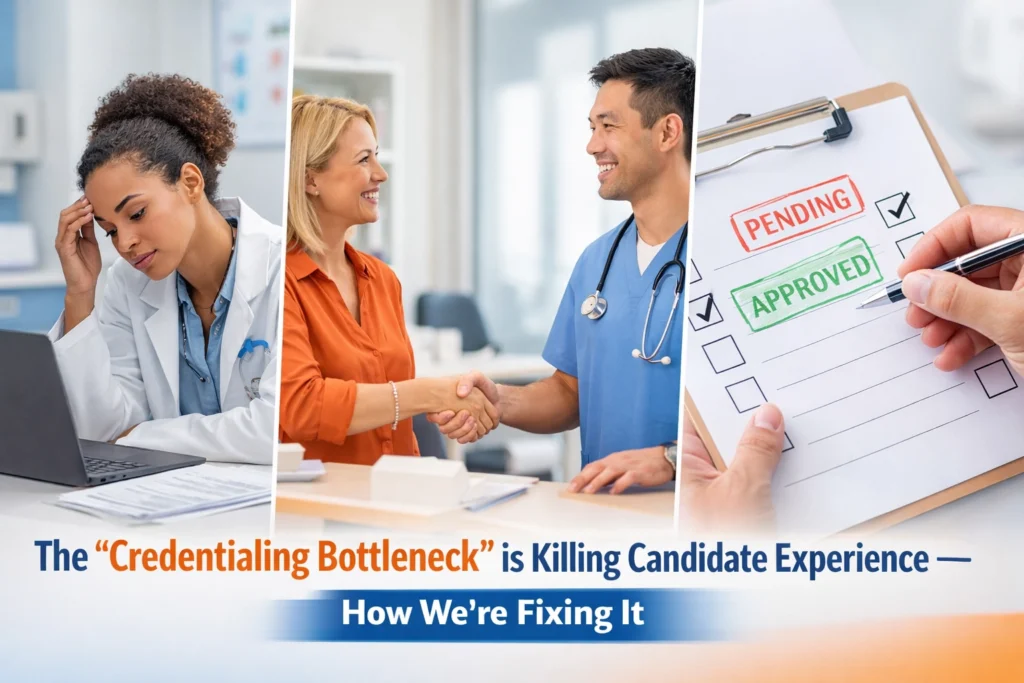
A talented ICU nurse, let's call her Sarah, reached out to us after spending six weeks trying to get credentialed with another healthcare staffing agency. Six. Weeks. And she wasn't even close to being done. She'd submitted the same documents three times, received zero updates about her status, and when she finally got someone on the phone, they told her they were "still working on it" and had no timeline to share.
She was done. Not just with that agency, she was ready to be done with travel nursing altogether.
That conversation stuck with me because Sarah's story isn't unique. It's happening every single day across the healthcare staffing industry, and it's absolutely killing the candidate experience. Worse, it's driving qualified clinicians away from opportunities they're excited about, and forcing them to question whether this career path is even worth the hassle.
The Credentialing Bottleneck is Real (And It's Worse Than You Think)
Here's the thing: credentialing has always been complex. I get it. We're dealing with healthcare professionals who will be caring for patients, so of course there's a rigorous vetting process. Licenses need verification. References need checking. Background checks need completing.
But there's a massive difference between "rigorous" and "ridiculously inefficient."

The problem isn't that credentialing requirements exist, it's that too many agencies are still operating like it's 1995. We're talking about:
- Faxed documents (yes, faxes still exist apparently)
- Manual data entry across multiple disconnected systems
- Paper applications that get lost in someone's inbox
- Zero visibility for candidates into where they are in the process
- No communication unless the candidate chases down their recruiter for the fifth time
Meanwhile, the nurse or allied health professional is sitting there in limbo. They can't plan. They can't commit to a start date. They're just… waiting. And hoping. And getting increasingly frustrated.
What Actually Causes the Bottleneck
After years in this industry and countless conversations with both clinicians and credentialing teams, I've identified the main culprits:
Fragmented Systems: When your credentialing team is using one software, compliance is using another, recruiters are tracking things in spreadsheets, and HR has their own database, nothing syncs up. Information gets lost. Steps get missed. Nobody knows who's responsible for what.
Manual Verification Processes: Calling seven different institutions to verify credentials, waiting for mailed responses, manually cross-checking every detail: this stuff takes forever when it's done by hand.
Poor Communication Protocols: Candidates submit documents into a black hole and hear nothing for weeks. When they do reach out, nobody can give them a straight answer because the information is scattered across five different places.
Sequential Processing: Many agencies wait for one step to completely finish before starting the next. Internal credentialing has to be done before payer enrollment begins. Everything happens in a slow, methodical line instead of in parallel.
The result? What should take 7-10 days stretches into 4-6 weeks or longer. And every extra day is another day that talented clinician is reconsidering their options.

The Real Cost Nobody Talks About
When we talk about credentialing delays, the conversation usually focuses on lost revenue and unfilled positions. Those are legitimate concerns, but I think we're missing the bigger picture.
We're losing trust.
Every time a qualified nurse like Sarah gets jerked around by an archaic credentialing process, she tells her story to colleagues. She posts in Facebook groups. She shares her experience with other travelers. And suddenly, your agency's reputation takes a hit: not because you're not placing people successfully, but because the experience of working with you sucks.
Healthcare staffing is a relationship business. We're not just matching credentials to job requirements. We're partnering with clinicians during pivotal moments in their careers. When we waste their time, ignore their messages, and fail to provide basic updates, we're telling them they don't matter.
And here's what really gets me: these are healthcare professionals who just spent the last few years on the front lines of a pandemic. They've dealt with enough bureaucratic nonsense. They deserve better.
How We're Actually Fixing This at Vitality Solutions
Look, I'm not writing this just to complain about the industry (though I'll admit it feels good to vent a little). I'm sharing this because we've spent the last two years completely reimagining how credentialing should work in a next-generation healthcare staffing agency.

Here's what we've built:
Unified Technology Platform: Everything lives in one place. When a clinician uploads a document, our credentialing team, compliance, and recruiters all see it instantly. No more "Can you resend that?" conversations. No more documents disappearing into the void.
Electronic Verification: We've partnered with verification services that can confirm credentials electronically in hours instead of weeks. License verification that used to take two weeks? Done in under 24 hours in most cases.
Real-Time Status Tracking: Our clinicians can log in anytime and see exactly where they are in the credentialing process. "Awaiting license verification from California Board of Nursing." "Background check in progress: 48 hours remaining." No guessing. No calling to ask for updates.
Smart Document Management: Our platform validates applications as candidates fill them out. Missing something? You'll know immediately, not three weeks later when someone finally reviews your file. Documents integrate directly with CAQH, so clinicians aren't typing the same information seven times.
Parallel Processing: We don't wait for internal credentialing to finish before starting payer enrollment. Things happen simultaneously wherever possible, cutting total timeline significantly.
Proactive Communication: Automated updates at every milestone. A real human checking in when there's a delay. Text message alerts when we need something. We keep candidates in the loop because that's just basic respect.
The results? Our average credentialing time is 10-12 days compared to the industry average of 4-6 weeks. But more importantly, our clinicians aren't pulling their hair out or threatening to quit the industry.
The Bottom Line
Technology-driven healthcare staffing isn't just about being trendy or having a fancy platform. It's about recognizing that the talented nurses, therapists, and allied health professionals we work with have options. Lots of them.
When you treat credentialing as a necessary evil instead of a critical part of candidate experience, you're actively choosing to lose good people. You're choosing outdated processes over innovation. You're choosing to frustrate clinicians instead of supporting them.
Sarah, by the way? She's now credentialed with Vitality Solutions and starting her assignment next week. The whole process took 11 days. She told me she "couldn't believe how smooth everything was" and has already referred two of her friends to us.
That's what happens when you fix the bottleneck. You don't just place more clinicians faster: you build a reputation as a healthcare staffing agency that actually gives a damn about the people making this industry work.
If you're a healthcare professional tired of being stuck in credentialing purgatory, or a facility partner frustrated with slow placements, let's talk. We're doing things differently at Vitality Solutions, and the results speak for themselves.
Because honestly? Life's too short for fax machines and six-week credentialing processes.